How to Assemble Garden Furniture This Summer

garden-furnitureWe’re promised a good summer this year, so the chances are many people will be looking at their existing garden furniture and deciding they need to replace it. That’s all very well, but there’s a fly in every ointment. With garden furniture, it’s having to put it together.

Garden Furniture Assembly

Unless you’re buying something high-end and bespoke, garden furniture normally comes as flat-packs, and that can cause problems. Even if no parts are missing, and even if the instructions don’t look like something produced by a thousand monkeys with keyboards, garden furniture assembly can be anything but intuitive.

No-one could be blamed for getting a handyman in, not only to avoid the hassle but also to make sure you don’t ruin furniture you’ve paid good money for. If you feel up to tackling it, though, following a few simple principles can save you a lot of frustration.

Essential Preparation

  • The first thing to do when you open a flat-pack is to lay out all the parts and check them against the list in the instructions (including counting screws). If something’s missing, don’t attempt to start assembly.
  • If the pack includes non-symmetrical parts (e.g. the right and left sides of a chair) identify which is which.
  • Make sure you have all necessary tools to hand before you start the process.
  • Find a space with a flat surface and big enough to work in comfortably.
  • Make sure you have enough time to finish. If you have to come back to it later, there’s a risk something will have been lost.

General Principles of Assembly

The exact procedure will depend on which item you’re assembling (e.g. table or chair), the material (e.g. rattan, metal or plastic) and the manufacturer. Here are a few general principles, though.

  • Always stick to the order the instructions recommend — there’s a reason for it.
  • Place the item so that you can get at the connections most easily. For instance, a table would normally be assembled upside-down.
  • To minimise damage, leave any protective tape or other materials in place until it’s essential to remove it.
  • Don’t fully tighten screws or bolts till assembly is close to complete, since it may make it harder to fit other screws or bolts in.
  • Use every piece provided — it’s there for a purpose.

DIY or Professional?

If you work sensibly and methodically, you should be able to assemble your own garden furniture. If you just want it done and on your patio and you’re looking for a London handyman to oblige, Handy Squad can have your garden furniture assembled in no time.
How to Bleed a Radiator

Radiators need to be regularly bled of excess air or gas to ensure they’re performing to maximum capacity. It may seem the wrong time of year to think about your heating system, but sorting it out now will ensure your radiators are ready for use when you switch them on again.

You may prefer to have this done by professionals, and if you’re looking for London plumbers or a handyman in London, Handy Squad would be delighted to help. It’s quite possible to bleed your own radiators, though, if you follow a few simple steps.

Bleeding your Radiators

1. Turn on your you heating system and wait until all your radiators have fully heated up. Unless you’ve built up the pressure inside, the air won’t come out when you open the valve.
2. When your radiators have been on for a while, check each one individually to find out if it’s heating up properly — but be careful not to burn yourself. Cool spots are most likely to be found near the top of the radiator, marking where there’s a build-up of air or gas.
3. Radiators with cool spots need to be bled. Turn off the heating, so you can carry out the process safely, and find the valve at one end of the radiator.
4. You’ll need either a radiator key (available from any hardware shop or DIY store) or a flat-blade screwdriver. Either fix the key to the square valve, or insert the screwdriver into the groove.
5. Have two cloths ready, one to hold the key or screwdriver, the other to catch any water that escapes. Turn the screwdriver or key slowly anti-clockwise. If you hear a hiss, that means the gas is escaping.
6. When the gas is all gone, water will start coming out — usually a dribble if you’ve used a key, or a spurt if you’ve used a screwdriver. Turn the valve clockwise immediately to close it.
7. Look at the gauge on the boiler to check pressure. If it’s low, use the “filling loop” to fill up — this will be a lever or tap on your boiler, and should be clearly marked in the manual.
8. Repeat steps 1 and 2 to make sure all air has been eliminated.

Make Your Heating Efficient

Bleeding your radiators will make a big difference to the efficiency of your heating system, but there are other things you can do, from putting insulation foil behind your radiators to buying a radiator booster. If you need assistance with any of this, Handy Squad offers help with plumbing in London.

How To Put Up Pictures

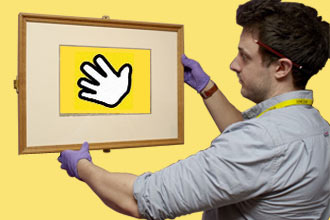
hanging-picture-thumbnailBefore hanging a picture on a wall you need to consider how large and heavy the picture is. This will determine whether more than one person is needed. Will a ladder be required and, if so, will someone else be needed to hold it in place?

Does the picture have hanging wires or hooks on the back that are capable of holding its weight? If not, then the appropriate fixings will need to be sourced and fitted.

What sort of wall is the picture to be hung on? This is crucial, particularly in the case of a heavy picture. Plasterboard walls are often not strong enough to hold heavy items. The fixings can simply tear out of the wall. The wall may therefore need to be reinforced. The type of wall will also dictate what sort of equipment you need.

For a standard size and weight of picture on a plasterboard wall, a hammer and nails/picture hooks should suffice, although a screw and rawl/wall plugs may be better in some cases.

For a brick/harder wall, a drill with masonry bits will be required to fit screws and rawl/wall plugs. Plastic pin hooks are very easy to hammer in, but ensure that you have enough of them to hold the weight (it should indicate this on the packet). The danger with these is that, over time, the plastic hooks can dry out and simply snap off. Finally, if the wall is concrete (every handyman’s nightmare!), an SDS/pneumatic drill (concrete drill) will be required to get those screws in.

Positioning the picture is crucial. Whilst we obviously will hang the picture where the customer wants it, there are factors the handyman must consider that the customer may have overlooked:

For example, are there any electrical sockets or light switches that would be affected / obscured by the intended position of the picture? You must also check what is inside the wall you are about to drill into. Wires and pipes should really be situated in the middle of a partition wall but not always, so it’s best to err on the side of caution.

Check the other side of the wall as well just in case, particularly if there is a shower or other appliance mounted on it. You can buy a wire detector (around £20+) which you just run across the wall and it will bleep to let you know where the wires are. Some will also indicate where the studs (wooden structure behind the wall) are located. Screwing into the studs will provide much more strength than just going into the plasterboard which is relatively flimsy.

So there you are, there is more to hanging pictures than meets the eye which is why we are called out to do it for our customers every day.

Types of Job a Handyman Can Undertake

Are you, like most people, unable or unwilling to tackle advanced DIY? The alternative doesn’t have to be finding specialists for each task. If you’re looking for a handyman London is well covered by the Handy Squad, who can complete most jobs as skilfully as any specialist.

Working With Wood

It’s very easy to see when carpentry hasn’t been done by an expert. A good handyman will make a professional job of major renovations like laying wooden flooring, building partition walls and installing new kitchen units. He’ll also tackle awkward jobs like hanging doors, where precision is everything, and repairing and sprucing up your sash windows.

Some jobs may seem simple enough till you compare the amateur and professional results. A handyman’s cupboard doors won’t work loose, and the shelves he puts up, whether for books, laundry or general purpose, will be solid and secure.

Decorating

Decorating seems a given for DIY, but it’s not as easy as you might think to get right. A good handyman can do an expert job on repairing the wall plaster, hanging wallpaper (straight!) and applying a smooth paint-job. In the bathroom or kitchen, he’ll re-tile your walls or grout your old tiles, and insert silicon around the bath or sink to keep it watertight.

Electrical Work

There’s no place for the enthusiastic amateur when it comes to electrical work, unless you want to risk burning the house down. A good handyman will be trained to do everything from replacing light-bulbs to installing or replacing switches, sockets, fittings and the like, and should even be able to test for faults in the system.

Plumbing Work

Flooding your home may be marginally less serious than burning it down, but all but the simplest plumbing, like electricity, is best left to the professionals. A good handyman will be able to install or replace fittings like taps, pipes, sinks, baths or showers, and repair pipes, radiators, toilets and much more.

Odd Jobs

Hanging up blinds, curtains, pictures, mirrors, TVs or shelves may seem simple enough, but they can look terrible if they’re not exactly right — not to mention the risk of collapse. And if you have flat-pack furniture to assemble, it can be much easier to let a handyman figure out how to fit A into slot B. Chances are, he won’t have that extra screw left at the end.

If your patio or garden furniture has got dirty (after winter, perhaps) a handyman should have the equipment to jet-wash it clean.

Contact us if you have any of these jobs you want to leave in the capable hands of a handyman.

Lift the Burden of Decorating with Professional Handyman Services

Doing your own decorating can seem a great idea when you first come up with it. After all, you have the ideas, you have the tools (or most of them, at least), you have a local DIY superstore for all your supplies. What could possibly go wrong?

You find out the answer halfway through, when it’s already taken longer than expected, it’s playing havoc with both your home and your social life, and nothing looks the way it did in your imagination. Perhaps you should have got a professional in, after all.

What Can a Handyman Do for You?

If you call in a good handyman instead, any disruption can be kept to a minimum and will be finished at the planned time, rather than three weeks later. Even more importantly, each aspect of the decoration will be done expertly, as you visualised it.

The range of services a handyman company such as the Handy Squad can offer is impressive, and goes well beyond painting and papering. For instance, the wall plaster may need repairing. This could be because of the cracks that routinely appear as a house settles, or to fill in holes left by picture hooks, curtain poles or light fittings. A handyman will carry out these repairs as expertly as a plasterer, so they’re left invisible.

Some repairs may be larger scale, such as boarding over and plastering a doorway you no longer need. A handyman can also repair silicone around a bath, basin or shower tray, removing the old silicone and applying it freshly to seal it perfectly watertight.

Wallpaper and Paint

Wallpaper looks great when it’s hung well, but an amateur job can look awful. A good handy man will cut and hang the strips perfectly straight with the pattern exactly matching up, just as you imagined it.

Painting generally looks easier than it actually is, especially if you have to match up with existing paintwork. Whether you need the whole house done or just an unsightly mark painted over, a handy man can do a professional job on doors, walls and floors. This includes preparing the surfaces, an essential process often skimped or ignored by amateur DIYers.

Find Your Handyman

The catch is, of course, that you have to find a good handyman, and this can depend on where you live. If you’re looking for a handyman Clapham and most of South London is covered by the Handy Squad, but if you’re elsewhere make sure their website specifies all these services. Find the right person, and you’ll never have to go through the headaches of decorating again.